Greenhouse Gas Inventory
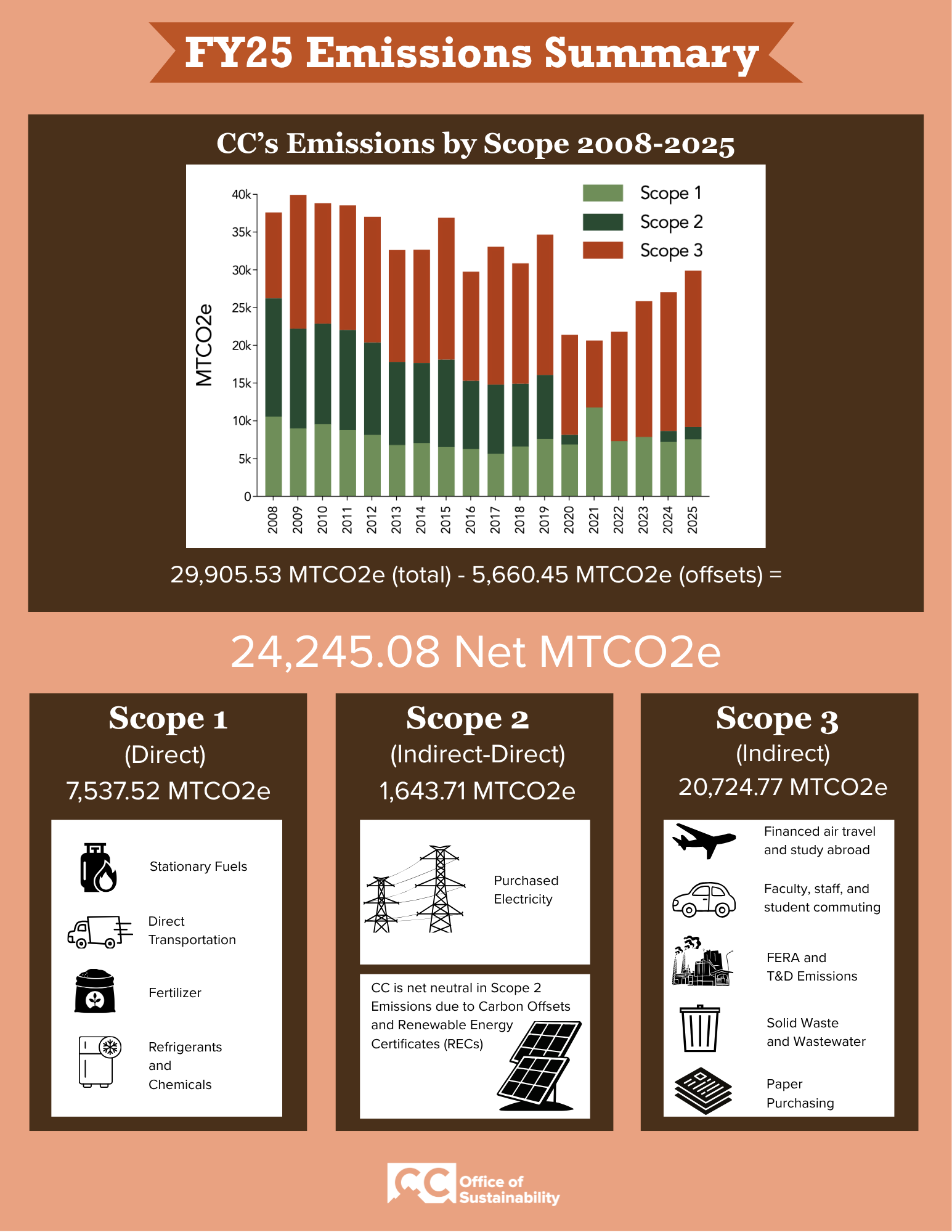
Every year, the Office of Sustainability’s Emissions team performs an inventory of Colorado College’s (CC) carbon emissions. The data from the inventory is used in the annual report, the Greenhouse Gas Technical Report. The goal of this report is to provide an overview of CC’s carbon emissions. It includes Colorado College’s gross emissions, as well as net emissions that take into account carbon offsets and carbon sinks.
The Report
The report provides information about greenhouse gases and the different "scopes" CC uses to differentiate sources of carbon emissions. It also explains carbon neutrality, carbon offsets, and Renewable Energy Certificates (RECs). The report covers all data collected during the FY23 greenhouse gas inventory process, beginning with an explanation of the methodology and ending with graphs from SIMAPⓇ, the online platform used for the inventory. Below is a quick snapshot of the current state of emissions at CC.
Learn More
Greenhouse Gases and Scopes
Greenhouse gases (GHGs) include gases such as carbon dioxide, water vapor, methane, and nitrous oxide. Solar radiation (sunlight) is absorbed by the Earth and released back into space. However, GHGs in the atmosphere absorb the energy that is trying to leave and radiate it back to the Earth. More energy is reabsorbed than is released; excess heat is prevented from leaving the atmosphere. This imbalance leads to global warming. Emissions from human activities are increasing the amount of GHGs in the atmosphere, which is exacerbating global warming. GHGs are measured in metric tonnes of carbon dioxide equivalent, or MTCO2E.
All GHGs have a different Global Warming Potential (GWP). This is the amount of heat absorbed by each gas in the atmosphere; the higher GWP a gas has, the more it will exacerbate global warming. Methane is 28 times as potent as carbon dioxide and nitrous oxide is 265 times more potent than carbon dioxide (IPCC). The unit of measurement for emissions, MTCO2E, scales methane and nitrous oxide emissions to their carbon dioxide-equivalent emissions so that all emissions are in terms of carbon.
Colorado College keeps track of GHG emissions by sorting them into categories based on their source. These are called “scopes”:
- Scope 1 - Direct Institutional: Scope 1 emissions measure direct emissions from sources that are owned and/or operated by Colorado College. This includes natural gas for heating, gasoline, and diesel for CC's vehicle fleet, and fertilizers and refrigerants.
- Scope 2 - Indirect Institutional: Scope 2 emissions measure indirect emissions from the generation of purchased electricity.
- Scope 3 - Indirect Behavioral: Scope 3 emissions are related to behavioral choices. CC has chosen to measure emissions from study abroad, faculty and staff commuting, student travel to–and from home, business travel paid for by Colorado College, solid waste and wastewater, paper usage, and T&D losses. These choices reflect CC's commitment to addressing and changing the behavioral patterns that drive indirect emissions.
Carbon Neutrality
On January 1st, 2020, Colorado College officially became a carbon-neutral institution. According to the Natural History Museum of the UK, “a person, company, or country is carbon neutral if they balance the carbon dioxide they release into the atmosphere through their everyday activities with the amount they absorb or remove from the atmosphere. This is also called net zero carbon emissions or net zero carbon because overall no carbon dioxide is added to the atmosphere” (NHM). CC’s status as a carbon-neutral institution does not mean that the college doesn’t produce carbon emissions. Any gross carbon emissions still generated by CC are balanced out by carbon offsets purchased by the college.
This year’s technical report is the first to fully account for carbon neutrality. It is important to note that FY20's greenhouse gas inventory occurred across the fiscal year, whereas CC reached carbon neutrality at the beginning of the calendar year. This means that carbon neutrality was met halfway through the emissions reporting period. For that year's report, Colorado College appears to be “half” carbon-neutral because offsets could only be applied to emissions from January 1st, 2020 onward. Last year’s (FY21) and this year's data (FY22) fully capture Colorado College having met carbon neutrality.
Offsets and RECs
GHG Reporting Data
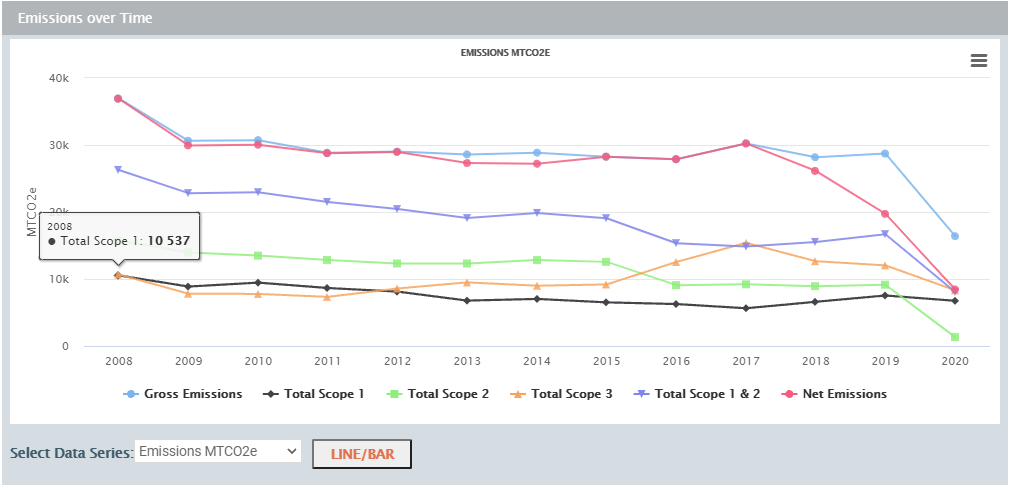
Colorado College tracks its carbon emissions by submitting annual reports to AASHE STARS® and Second Nature, two organizations dedicated to assisting and tracking sustainability initiatives in higher education institutions. To view CC's emissions data, click on the graphic below.
Quick Facts
- CC’s Baseline Year: 2008
- Units Used to Quantify Carbon Emissions: Metric Tonnes of Carbon Dioxide Equivalent or MTCO2E
- Achieved Carbon Neutrality: January 1st, 2020, which means CC has 0 net emissions
- Renewable Energy: 100 % of CC’s purchased electricity comes from renewable energy
- How Did We Do It?: On-campus projects (building renovations, efficiency upgrades, on-site renewable energy) and investments in carbon offsets and Renewable Energy Certificates
- Main Source of Carbon Offsets: An investment in the Larimer County Landfill Gas Destruction Project in Fort Collins, Colorado, that converts methane from landfill waste into electricity