
Majors Info
Geology Curriculum | Course Grid | Major Requirements | Course Sequence | Outside Credit/Study Abroad
Geology Curriculum
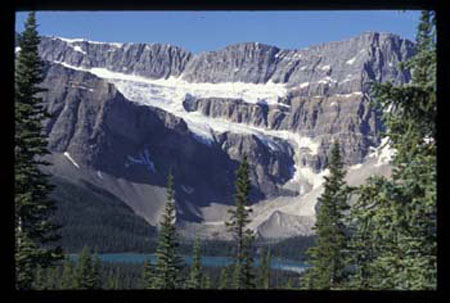
Most courses are field-oriented and include day-long field trips in the local Colorado Front Range and multiday, sometimes multi-week, trips through Colorado and into New Mexico, Utah, Arizona, and Wyoming. We thus take advantage of the spectacular and varied geology of the Rocky Mountain, Basin and Range, and Colorado Plateau Provinces and from time-to-time travel further afield throughout the US and Canadian West. Courses use modern field technologies (including GPS, digital mapping and geophysical methods) as well as traditional field approaches. On campus they make use of Geographic Information Systems (GIS) and other computer software.
Introductory geology courses spend a substantial amount of the class time studying natural outcrops, with students learning how the diverse rock types in our region form, and their stratigraphic and structural relationships. Students undertake guided research on a variety of topics.
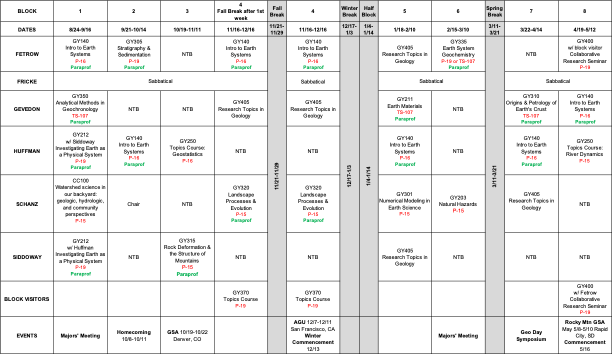
Students start the major by taking GY 211 Earth as a Chemical System and GY 212 Earth as a Physical System. These courses cover mineralogy, petrology, surface processes, structure, tectonics and geophysics principles within the context of Rocky Mountain geology. The courses are project focused, involving both extensive fieldwork and on-campus data analysis and writing. They serve as prerequisites to the 300-level courses.
Stratigraphy, Sedimentation, Paleontology, and Historical Geology courses cover the nature of sediment and analysis of sedimentary structures to interpret modern and ancient depositional systems; marine invertebrate phyla, ecology, and evolution; and geological evolution of the Earth through time.
Surface processes examine surficial processes and landscape evolution in environments ranging from the desert Southwest to the Colorado alpine. Courses involve students in field project design, data collection and analysis, and GIS work.
Structural Geology and Geophysics explore the architecture of Earth's lithosphere, from near-surface through subsurface, including mantle depths. Emphasis is upon the application of field instrumentation and methods to investigate mountain-building processes and continental tectonics, using field sites in the nearby Rocky Mountains and beyond.
Petrology and Geochemistry of the Rock Cycle courses examine minerals and rocks in detail, the geochemical principles that govern how elements are partitioned between earth reservoirs, and the conditions of their formation.
Major Requirements
- Printable Major Requirements pdf (rev. Jan 2026)-
GEOLOGY MAJOR REQUIREMENTS (approved January 2026)
Students must receive a course grade of C-/S or above for each course taken at CC for it to count toward the Geology major.
1. One unit at the introductory level:- GY140 – Introduction to Earth Systems
- GY211 – Earth Materials
- GY212 – Investigating Earth as a Physical System
- and one Geology elective at the 200-level (GY207 excluded)
- GY305 – Stratigraphy and Sedimentation
- GY310 – Origins & Petrology of Earth’s Crust
- GY315 – Rock Deformation and the Structure of Mountains
- GY320 – Landscape Processes and Evolution
- GY335 – Earth System Chemistry
- GY301 – Numerical Modeling in Earth Science
- GY316 – Field Analysis of Geological Structures
- GY350 – Analytical methods in Geochronology
- GY345 – Regional Studies in Geology
- GY370 – Advanced Studies in Geology [Topics vary]
- GY400 – Collaborative Research Seminar (if not used to satisfy category F)
- Any 300 or 400 level course in the Geology Department (GY405 excluded), provided it is not used to satisfy the Category C, D, or F requirement
- Upper-level course(s) from another institution or from a Department in the Natural Sciences at CC, provided the course is directly related to geoscience skill set. A written request and rationale must be provided to receive consent of academic advisor or department Chair.
6. One unit of “Capstone Research”, selected from
- GY400 – Collaborative Research Seminar
- GY405 – Research Topics in Geology
7. Four units of “Foundational courses in the Natural Sciences.” AP test scores of 4 or 5 (if recorded on CC transcript) may be applied toward 2 of these 4 courses.
- One unit of Physics breadth: PC141 – Physics for the Life Sciences I or PC241 – Physics for the Physical Sciences I; or higher in either series
- One unit of Chemistry breadth: CH107 – General Chemistry I or higher in the series; CH17 – General Chemistry 1 with Environmental Emphasis
- Two units of Math/Computer Science breadth:
- One of: MA125 – Precalculus & Calculus 1 or MA126 – Calculus 1
- One of: CP115 – Computational Thinking; CP116 – Applied Python; MA117 Elementary Probability and Statistics; MA120 Applied Linear Algebra; MA129 – Calculus 2; MA217 – Introduction to Probability and Statistics; MA220 – Linear Algebra; or MA275 – Sequences and Series.
12 GEOLOGY UNITS TOTAL
Course Sequence
- Printable Major Flowchart pdf -
Specializations
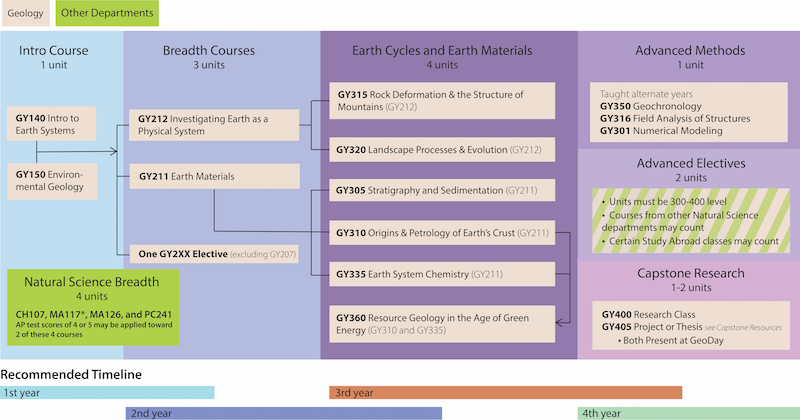
Surface Geology GY305, GY315, GY320, GY335
Subsurface Geology GY305, GY310, GY315, GY360
Physical Geology GY305, GY315, GY320, + one
Geochemical GY310, GY335, GY360, + one
Additional Information
All majors must pass courses listed in categories A through G below with a grade of C–/S or above
Outside Credit
AP Credit
- AP credit (score 4 or 5) is accepted as a replacement for up to two of the Natural Science Breadth courses (CH107, MA117, MA126, PC241)
- 1 AP credit can be applied to MA117 OR MA126, not both
- One needs the consent of their Geology Advisor or Chair
- While additional AP credit cannot cover the remaining Natural Science Breadth courses, students may select the next higher course in the department's sequence.
Study Abroad
- Off-campus may substitute for one required and one elective major course
- Students must submit a written request that justifies the substitution to the department chair
- Requests will be considered by the Geology Faculty and must be approved before course substitution(s) are accepted
Study Abroad Options
New Zealand Frontiers - 5 week field program + Campus semester at the University of Canterbury
ACM Spring semester in Costa Rica (Spanish Required)
Edinburgh, DIS Denmark, Study Abroad in Scandinavia
Are You Thinking About Grad School?
The department strongly urges students to take additional courses in geology, environmental science, mathematics & computer science, chemistry, physics, and biology, and/or the GY400 Collaborative Research Seminar in Geology.
In summer, important academic and professional opportunities include a geology field camp offered by a university program, an internship that offers career and employment experiences, or/and field or laboratory research opportunities with a CC Geology professor or off-campus program.