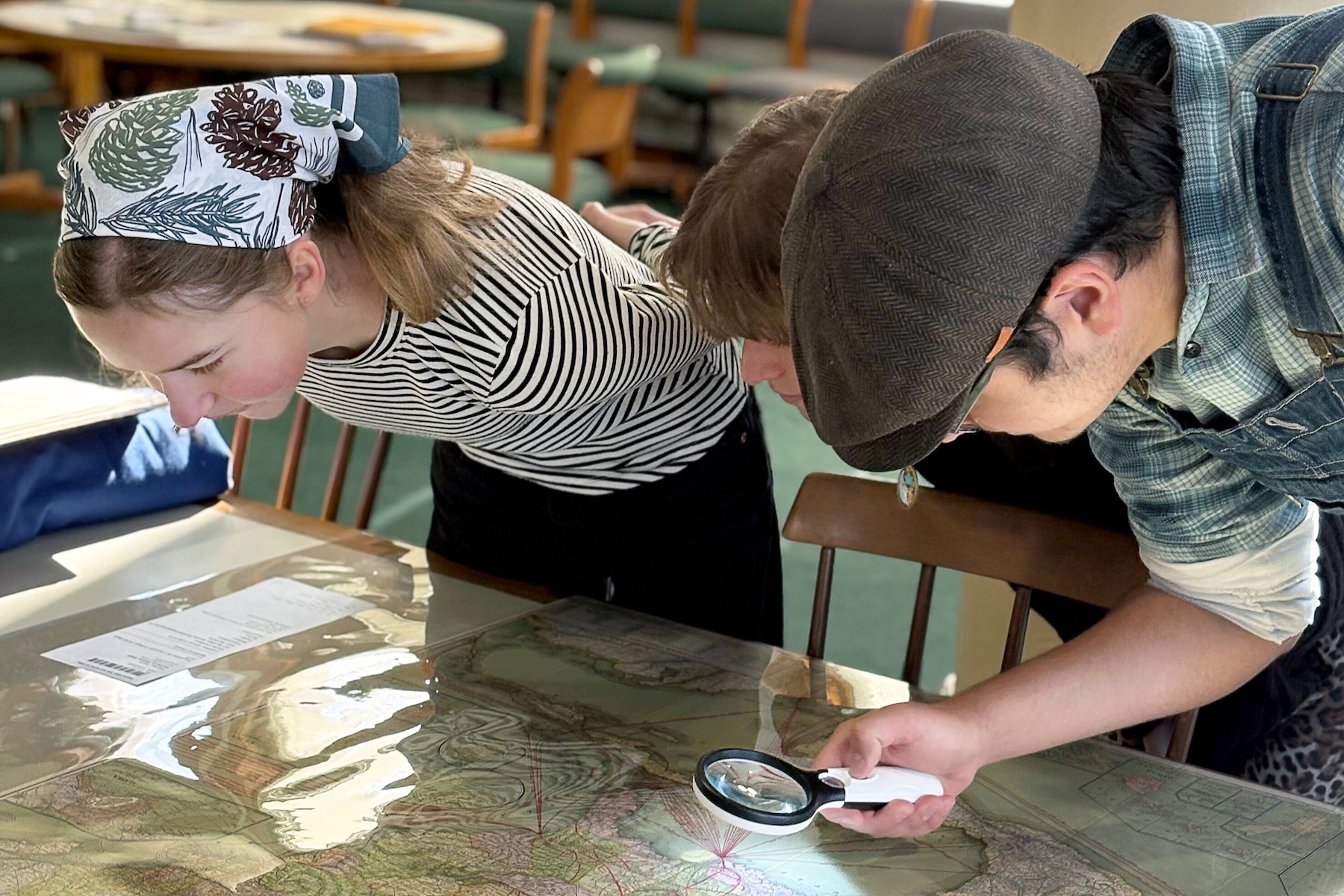
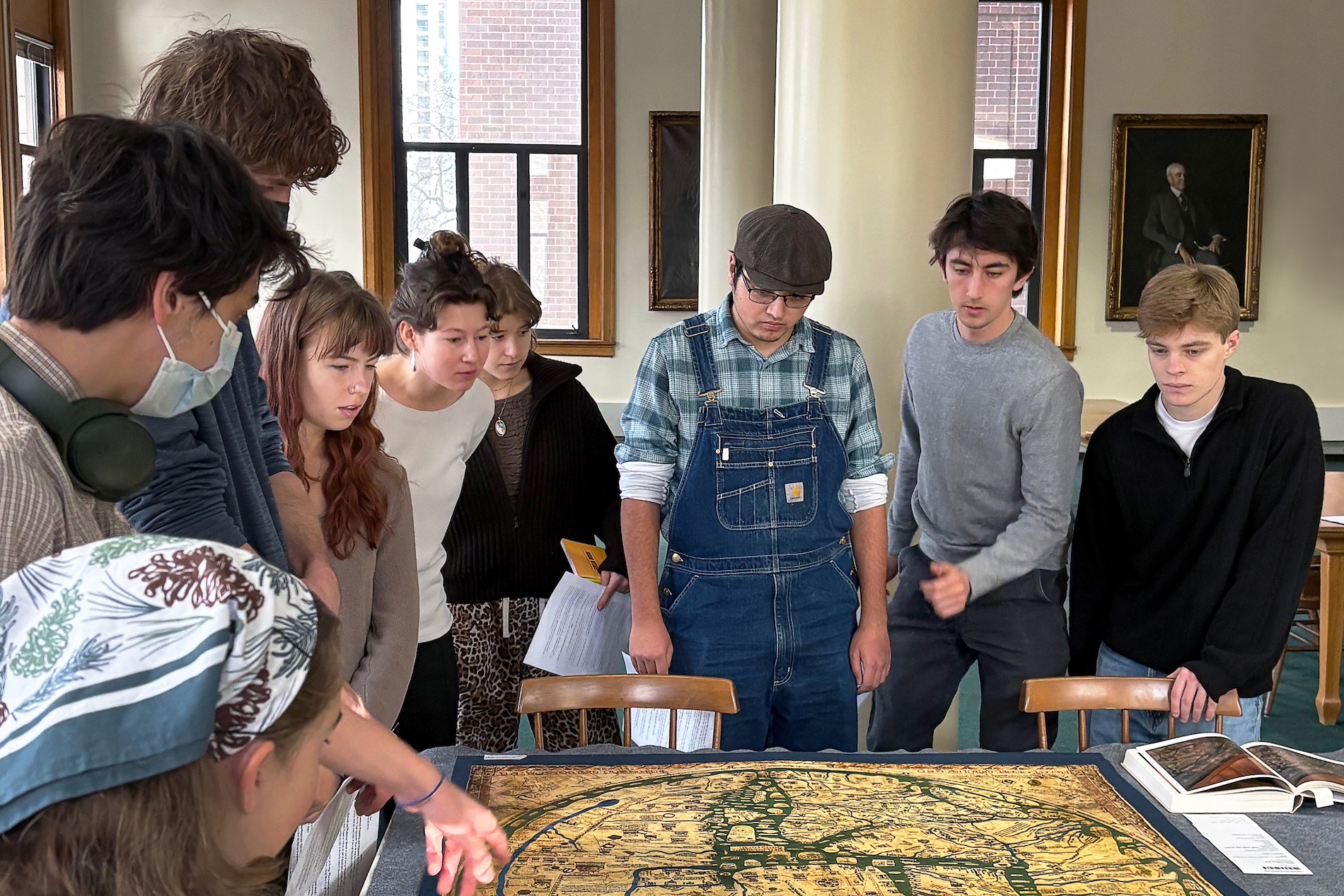
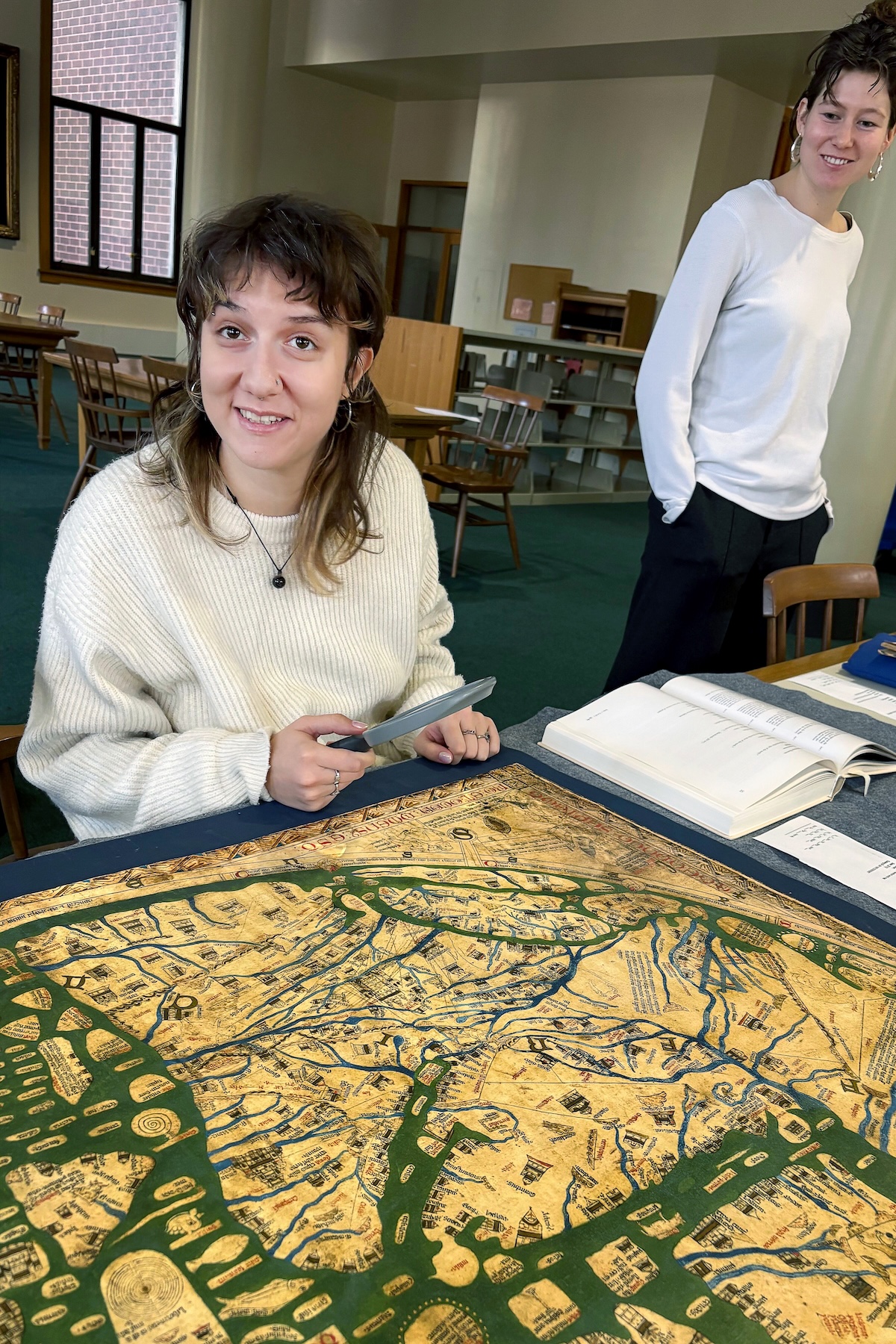
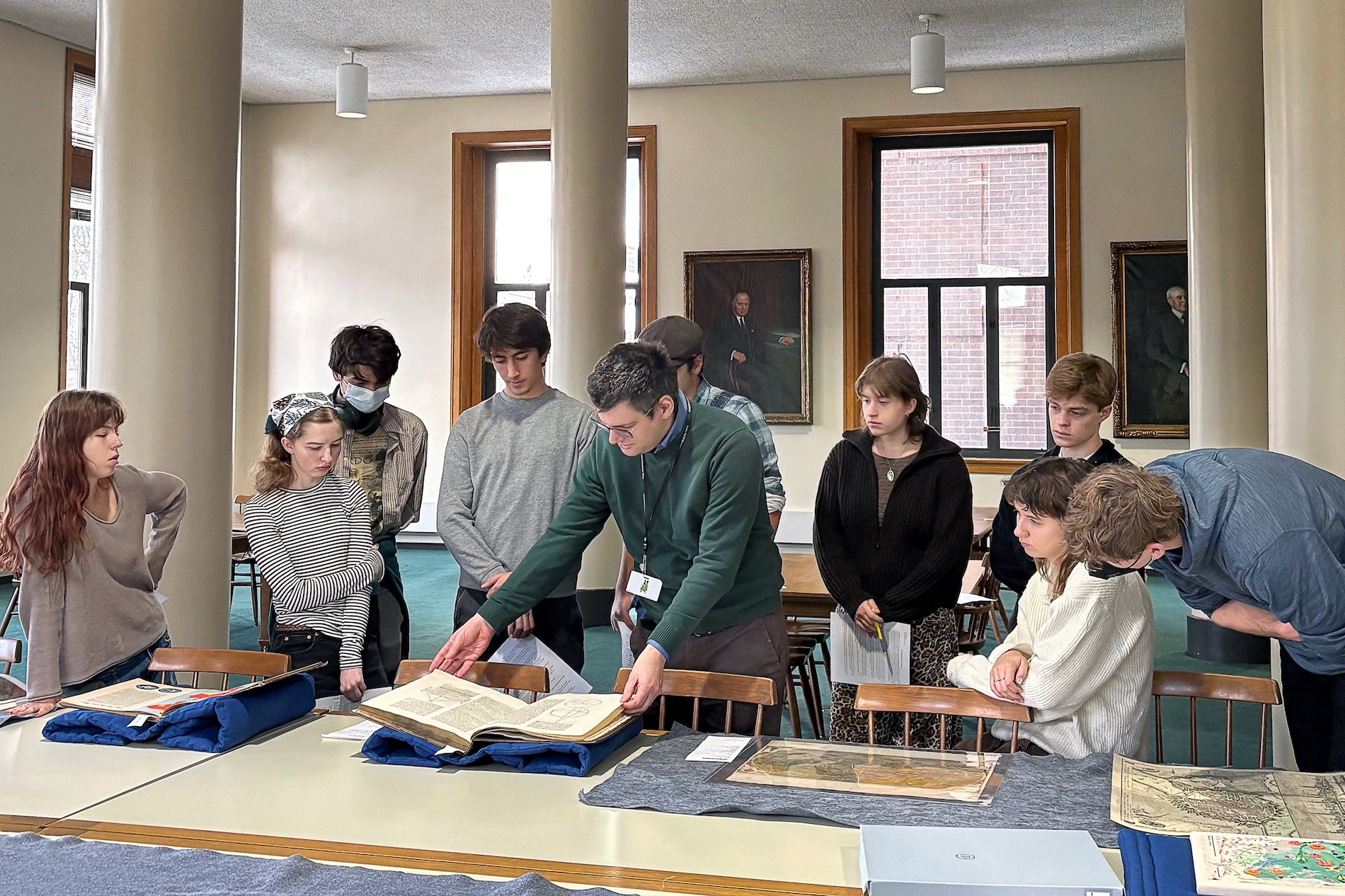
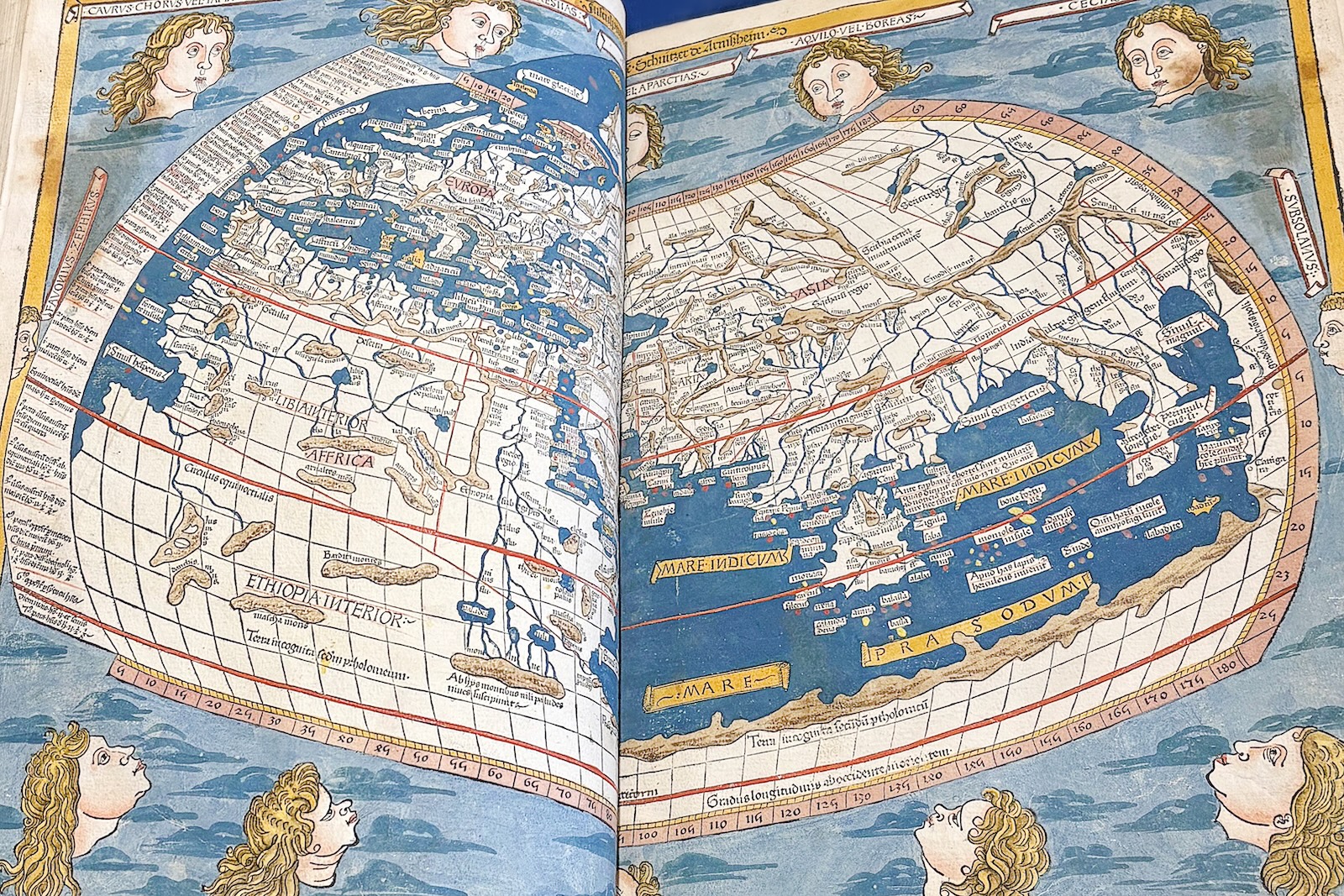
For senior History majors, a block at Chicago's Newberry Library helped them bring their final research projects to life using historic letters, maps, photo albums, business documents—and even century-old wedding cake.
“For me, this class is the argument for the Block Plan,” says Amy Kohout, Associate Professor of History. “We can pick up our senior seminar and take it to Chicago, where our students get to conduct their thesis research as junior fellows at the Newberry Library—a world-class archive.”
Known for its remarkable primary sources—like “a letter from Michelangelo or a doodle drawn in a nineteenth-century textbook by a procrastinating student,” its website notes—the Newberry also allowed students to work alongside subject matter experts, fellows in residence, and visiting scholars.
“In addition to having extraordinary archival resources, the Newberry is a hub of wonderful human resources,” Kohout says. “There's something really special about an undergraduate opportunity to be working alongside practicing historians, having opportunities that I didn't have until five years into graduate school.”
The Newberry
- Established 1887
- 27.5 miles of bookshelves
- Spans 600+ years
- 1.6 million books
- 600,000 maps
- 5 million manuscript pages
Discovering what it's like to take an extended research trip is central to the block. Living in Chicago is a chance “to hit pause on your regular life and throw yourself into all the reading and writing and researching that's part of conceptualizing a project,” Kohout says. By the end of the trip, students have a prospectus and work plan to bring back to campus, ready to write and workshop.
It's also the first time they're independently project-managing an article-length thesis, “rather than the professor saying, ‘I need you to write 4-6 pages using these materials in response to this question,’” Kohout says. The goal becomes: “How do we turn that into a really excellent research question—and then what sorts of materials might help answer that question? Then we go look at those things.”
That's where the wedding cake comes in.
Researching women's domestic labor and memory work, Zoe Williamson '26 drew upon the Newberry's historic family album collections, “and in one of these boxes—I've been talking about this all block because I just thought it was so cool—there was a piece of wedding cake from the late 19th century,” Kohout recalls.
“It ended up being quite the treat!” says Williamson. “It was so crazy to see all the different things an archive might hold and think of how that one object might branch out into all sorts of research directions.”
“I think helping students experience those moments of exuberance is important, because a lot of archival work is just very carefully and methodically going through a lot of paper, and it can be a slog,” Kohout says. “So those moments where you get really excited, where you turn the page and there’s something you didn't expect to find—that's magic.”
It can mean finding hidden treasure, she says, but also hidden sadness. Archives are “these unbelievably priceless assemblages of stuff—but the flip side is to reflect on whose lives are represented in an archive, and whose lives we might only see through fragments.” For some people, all that survives in the archive is a record of pain or violence. With these records, students reflect on their obligations as historians "to tell complex, multidimensional histories that don't just reproduce power dynamics, but help us to think in complicated ways about the past.”
“So there's the magic and the cake,” Kohout says, “but there's also encountering trauma in the archive and thinking through: What is my commitment to this work? What are the ethics of practicing history, and how do I think about approaching the project that I'm trying to research and put together?”
HY410/HY420 Senior Theses
- Neither Here nor There: Impossible Decisions of the Pacific War (Evan Cote '26)
- The Limits of Law and the Sovereignty of the Spirit: Conflicting Interpretations of the Mahele in Hawaiian Land Activism (Jeremy Jarecki '26)
- Halley's Comet and a View from Cuba, 1910 (Aden Katz '26)
- Sanctuaries of Power: Black Wilderness in North Carolina's Coastal Plain (1800-1865) (Will Myers '26)
- Statist Myopia: The True Fight of the Serbian Students (Mila Naumovska '26)
- Charting a Colonial Course: Hokkaido in Five Maps, 1785-1908 (Mohan Raghunath '26)
- Sitting on Top of the World in Cuba and Pennsylvania: Views from the Hershey Chocolate Company's Model Towns (Willa Schendler '26)
- Blood on the Main Line: Labor Violence and Control on the Illinois Central (Felipe Singer '26)
- "From A Dead John's Pocket": Symbolic and Economic Looting in the American Civil War (Emma Snow '26)
- Leisure and Labor: Maternal Memory Curation in Twentieth-Century Photo Albums (Zoe Williamson '26)
- Please Close the Iron Curtain Behind You After You Escape: Political Memory at the Site of the Pan-European Picnic (Felix Battle '26)
- The Afterlives of Dada (Kwynne Blaivas '26)
- The 1973 ‘Shower-In’ Demonstration: Archival Silences, Narrative Power, and Exposing an Administrative Cover-Up at Colorado College (Ethan Castette '26)
- Narratives of Immigration: The Immigration Restriction League as the Driving Force behind Immigration Restriction, 1890-1924 (Luke Donaldson-Reid '26)
- A Deep-Sea Dilemma: What The South China Sea Can Teach Us About The Future Of Arctic Maritime Cooperation (Ashley Entwistle '26)
CC history professors rotate through teaching HY410: History Senior Seminar so the block away can be offered every year, and all students have the chance to “experience one of the things that’s so exciting about being a history major and writing a history thesis.”
That range of discovery plays out differently for each student.
Mohan Raghunath ’26 focused on the colonization of Hokkaido, Japan, and used the Newberry's map collection to examine how indigenous people in Japan were represented in cartographic context.
Felipe Singer ’26 drew on the Newberry’s corporate documents, letters and maps for his thesis focusing on the Illinois Central Railroad and a violent incident during the strike of 1911.
Williamson, focusing on family albums, says the central message of her thesis is that women’s labor shows up in many forms, and “labor traditionally carried out by women can masquerade as pleasurable, making it even more important to examine in order to disrupt gendered labor expectations. I also want to emphasize how everyday objects from ordinary people can inform historical research to shape how we think about the present.”
And Evan Cote ’26 worked with “a really extraordinary collection of letters” written by a Japanese citizen who moved to the U.S. just before World War II, only to be incarcerated in a concentration camp during the war. Written after he was released, his letters went to a friend who was still in the internment camp. Cote “was poring over these letters, puzzling through the handwriting,” Kohout recalls, “and thinking a lot about what it might have been like for this man to be grappling with a sense of identity during a period of great turmoil.”
Cote says he hopes his writing conveys the real and lasting weight of decisions—especially those made by people in power.
“The U.S. government during the Pacific War made decisions that displaced hundreds of thousands of people. It stripped them of their rights and liberties, and their property,” he says. “By reading my thesis, I hope people understand that these actions and their impacts cut deep into the lives of these people, no matter their differences or similarities.”
The long work of research, refinement, iteration and reflection “is scary, it's a little stressful,” Kohout says, “but I think it's because we care so much about producing something that feels like it really does reflect the arc of a liberal arts education.
“To create something you are proud of—that's special.”